

MIES
Isabel Englebert presents "Mies", a luminaire sculpture designed exclusively for architects’ Julio Oropel and José Luis Zacarías space at the Design & Art Center in Patagonia Flooring Foundation, in Buenos Aires, Argentina.
From inspiration and sketches to composition and materialization, this luminar sculptures’ design is founded on rational thinking and pure geometry as the ideal of forms. MIES collection is characterized by its modern inspiration and modular composition, as well as by an innovative combination of materials such as brass, acrylic and live moss. This piece is also inspired by nature and sustainability. That is why Isabel Englebert partnered with Paloma Teppa, who spearheaded these fundamental design principles, and thus included Plant the Future’s live moss. The hybrid born of the interaction of brass and live moss makes reference to the concept of "life". At the same time, the symbolism of framing a piece of nature gives it the character of a work of art.
The principle of rationalist architecture is embodied with modern materials, a right angled figure, and simple geometric shapes organized in a modular way, isolating the base structure. The suppression of ornaments and curves create a functional, modern, harmonious and aesthetic architectural object.
Mies was exhibited for the first time on September 3rd, at Domestika Argentina’s launching, and will continue to be displayed at Patagonia Flooring’s Design & Art Center, at a permanent exhibition intervened by the country’s best architects and designers.


Detail
NEO

The Neo light sculptures, inspired by Neo-Geo - a conceptual art movement born in the 1980s in the United States - combine minimalism, op art and geometric abstraction. In this way, the artist Isabel Englebert works only with the essential elements, generating visual effects with pure and abstract morphologies, in which the simplicity of the forms and the linear character are the protagonists. Works of strong retinal impact, imprinted with the artist's characteristic signature.
Even when the figures that build the pieces are abstract, they allude to reality. This characteristic is partly drawn from the artist Peter Halley, one of the main referents of Neo-Geo, who uses geometric abstraction as a mechanism to refer to the social space of the world in which we live. Thus, in this piece, schemes and graphics of modern society are translated: squares and rectangles as "social cells", lines as social networks and communication routes.
Isabel Englebert establishes a relationship between the approach of the Neo-Geo movements and the current situation of how society is affected by the pandemic. During the months of confinement, the artist observed how the pandemic situation not only isolated individuals, but entire regions. Divisions and groups were generated within the country, which looked askance at each other, seeking to avoid new transmissions within their own region. For some time, it seemed that Argentina was made up of separate parts, individual regions completely partitioned from each other.


Process


The artist's vision is one of hope, which seeks to reconstruct unity: each element that composes these pieces is linked to the others, creating clusters that combine and give rise to a new figure, which is much more than the sum of the individual elements. Metal represents solidity and eternity, as it is what materializes the connections between each of the parts. Acrylic brings transparency and lightness, allowing the light to be filtered in order to create an illuminated and subtle atmosphere. A holistic, encompassing and unifying composition.
PAMPA


Pampa (Render)

Inspired by the Argentinian Pampas, Isabel Englebert presents a unique, luxurious and majestic series. Incorporating rationalist atributes, she once again challenges the borders between art and design. In this way, she creates an ode to geometry, imprinting her signature traits in her own interpretation of the Pampa.
A modular structure, geometric and pure, made of brass plated iron, functions as the table’s base,traversing through the surface and leaving its trace on the marble or parchment.The same degree of importance is given to the frame and to the top plane,transcending the object itself and rethinking the relationship between structure and surface, function and aesthetics.
Pampa (Detail)

Conceived in two alternative materials, the magnificent marble top evokes the characteristic Argentine Holando cow, through a unique piece of Dalmatian marble. Its distinctive pattern lends an apparent warmth to an inherently cold material.
The parchment, soft and warm, refers to the organic and traditional of the artist's country of origin. In this way, the spaces generate an almost immediate connection with nature, providing a fresh and, at the same time, sophisticated atmosphere.
Each Isabel Englebert piece is timeless and unique. All of them are made by highly skilled artisans, not only to ensure the highest quality, but also to encourage the preservation and development of traditional knowledge and the small business economy.
Pampa (Sketch)


PAPYRUS

From inspiration, sketches, composition and materials, PAPYRUS is inspired by the influence of Egyptian art in the Art Deco movement. It captures the essence of the union of the elements from their roots and gives life to a piece that tells a timeless story.
Influenced by cubism, constructivism, futurism and Art Nouveau itself, among others, art deco was characterized by its innovative style with hard lines and the rigidity of its forms present in the monumentality of its compositions. Elegant, functional and modernist, the symbolism of Art Deco revolves around progress, urban and organization, making decoration as its priority.
The artistic current was inspired by global concepts from the rustic tribal designs of Africa, the elegant sophistication of Paris, the geometry and sculpture used in ancient Greco-Roman architecture, and the representational forms of ancient Egypt with the stepped pyramidal structures. The Egyptian design focuses largely on decorative patterns, luxury, geometry and brightness motifs that fill the space and exalt the purity of the forms. Art deco finds its roots in ancient Egyptian art.
It is characterized by the luxury of its smooth, shiny and untextured materials. Metals, glass and patterns that fill the space. The ornamental profusion, the frequent use of lines and pure geometric forms in a repetitive way to generate patterns. In addition, it seeks to exalt some aspects of nature such as bright sunbeams and speed.
Papyrus is inspired in returning to the roots of art deco to create a timeless piece that illustrates the greatness, elegance and sophistication of Egyptian art. Its geometric figures, rigid and pure lines reflect the strength of its culture and the artistic movement. Likewise, the patterns engraved on the acrylic represent the use of papyrus to tell stories, on the other hand the brightness of brass alludes to luxury and the ostentation of the moment.


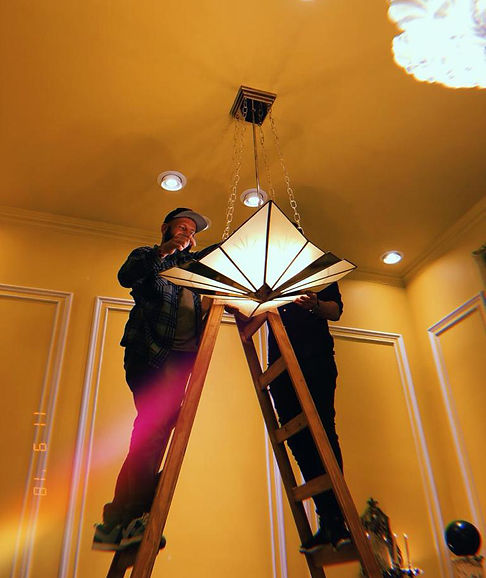
Papyrus was exhibited in the architectural space "Living of a collector" created by Javier Iturrioz for Casa Foa 2018. A symmetrical, monochromatic, sophisticated and eccentric space, destined for a true lover of antiquities and collector of contemporary art.
1925

Inspired in the Art Deco era, Isabel Englebert creates this set of unique lamps called “1925”.
They draw their name from the year in which Art Deco is born after the International Exhibition of Modern Decorative and Industrial Arts, in Paris.
The pieces have typical Deco features, as the combination of geometric, rectilinear, and symmetrical figures, which are represented by metals such as silver and well polished brass, in order to highlight its shine. With her characteristic DNA, Isabel incorporates the semi-precious stone Onix and the typical textures of the time, turning these pieces into unique and timeless ones.

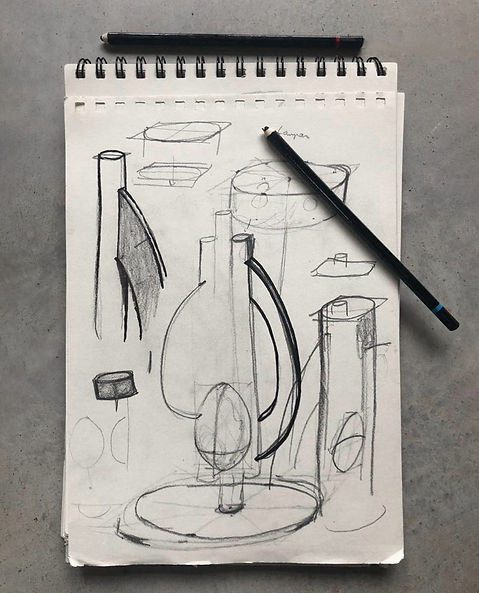

First Sketches