

PHI

The Phi series reflects on the relationship between the celestial bodies that make up our universe, highlighting the golden ratio that is inherent to this framework. Each element is in perfect harmony with the pieces that surround it, generating balance in a drawing that refers to the planets, their orbits and movements. Isabel Englebert proposes a metaphor, an abstraction of the movement of the sun in the universe and the relationship between the different trajectories that describe the astronomical objects as a dynamic framework.
The golden ratio is the foundation and pillar of each composition, in which each component corresponds to this numerical sequence, positioned in such a way that the contact points between two pieces give existence to a third one, whose proportions are the sum of its two predecessors. This relationship is a replica of the proportional sequences of the reality of the universe, which are expressed in the scale relationship between the Earth and the Moon, in the orbits of Mercury, Venus, the Earth, Jupiter and Saturn, or in the number of days of orbit around the sun of Venus and the Earth, among many other cases.
The variety of materials and textures refer to the dynamism and multiplicity of bodies in the cosmos. The use of hammered metal that reminds us of the moon, the blue color that can refer to our planet, the different weights transmitted by the plenums and fretwork, are points of connection that allow us to establish allegorical relationships to physical reality.

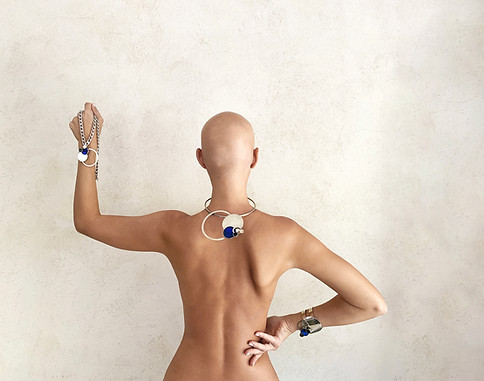
Among the different levels of significance that emerge from the Phi series, a link can be established between its morphological composition and that of Neo-Geo, with its geometric abstraction and simplicity of forms. The compositional elements are transformed into synthetic signs that refer to reality, arousing both conceptual reflections and aesthetic admiration.
A great admirer of Olafur Eliasson and his meditations on the environment, the artist elaborates a symbiosis between cosmic reality and artwork, which seeks to capture the dynamism of the universe and the relationship between the whole and its parts, focusing especially on the golden ratio that exists between the elements of the orb.


Necklace


Earrings
GLACIER
The glacier ice cap is shrinking annually between half a meter and one meter, which means between double and triple the average melting rate in the twentieth century.
The series of pieces "Glacier", created by Isabel Englebert, seeks to raise awareness about the problem of glacier melting. In her active commitment to sustainability, the artist raises this issue from a new place, creating situations that represent reality and invite to act on it.
The pieces are made of alpaca and raw quartz, conceiving an interesting interaction between both materials. On the one hand, the quartz presents characteristics of ice, resembling it in its hardness and luminosity. But on the other hand, the metal, which is cold in nature, is in a state of melting, generating an analogy with the slow transition of glaciers from solid to liquid state.


PLANTS
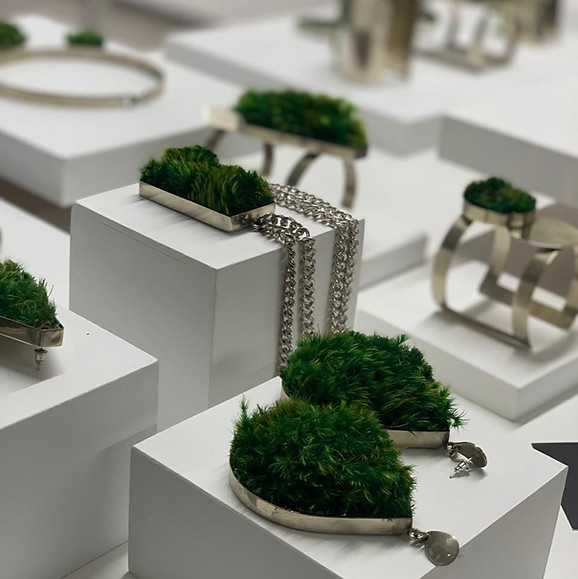
"Plants" is a series of pieces created with the collaboration of Paloma Teppa, an artist specialized in Biophilia, is the creator and alma mater of "Plant The Future", a nature-inspired design studio, plant boutique and botanical art gallery.
Isabel Englebert, multidisciplinary artist, provides the pieces of this series with her distinctive aesthetic elements: pure geometries, simple lines, and ruled surfaces. The line as a geometric element emerges to provide a perfect balance to each work, bestowing it with its own personality.
On this occasion the pieces incorporate live moss, creating a particular alloy that expresses the strong commitment of the artists with nature and sustainability. The rigidity and coldness of the metal combine and contrast with the warmth and softness of the moss. The former - strong, passionate - meets the latter - nourishing, living - to give birth to a hybrid born from the interaction of both materials. This mixture, this clash, represents life itself.
At the same time, this unusual encounter outlines a double meaning. On the one hand, it poses the action of framing a piece of nature, giving it the character of a work of art. It exalts it, it honors it in an unconventional way. On the other hand, it seeks to protect and care for the source of life, expressing a strong respect and commitment.




CALATRAVA
This series of sculptural pieces constitutes an ode to the brilliant architect Santiago Calatrava, and his unique and elegant aesthetic. Materialized in shiny silver and curved acrylic, these works refer to the architect's meandering lines, austere white materials and pure use of glass and light.
Isabel Englebert draws reference to some of Calatrava's most recognized and impressive works. Thus, the Lyon Saint-Exupéry TGV Station, the Tenerife Opera House and the Palau de les Arts become pure and synthetic geometric abstractions.
The architect's unique and symbolic style is recognizable in the sense of movement that Englebert's objects convey. Pieces that make reference to the joining of architecture, engineering and sculpture in a single project.

Lyon Saint-Exupéry TGV Station


Sketch

Earrings
Necklace

Palau de les Arts Reina Sofía, Valencia

Tenerife Opera House


Earrings


Bracelets
POLO
Inspired on the Polo sport, a traditional Argentine sport, Isabel Englebert gives life to a collection of small, minimalist and imposing objects. Incorporating the morphological characteristics of rationalism, the artist develops this series of works in noble materials that represent the essence of the Argentine land.
The horse's mane, soft and warm, is a direct reference to this sport, which is so representative of the local culture. The horsehair refers to the organic and traditional aspects of the artist's country of origin, revaluing tradition, yet at the same time proposing an unexpected innovation. Thus, she achieves an almost immediate connection between the objects and nature, providing a fresh and at the same time sophisticated atmosphere. A pure, geometric, modular structure, crafted in silver alpaca, draws paths that engage with the body. The metal creates a contrast with the mane, highlighting its shine and hardness.
Once again, Englebert challenges the boundaries between design and art. She creates an ode to geometric abstraction, imprinting her personal stamp of pure lines and simple figures on her interpretation of the Argentine Polo.


KINETIC
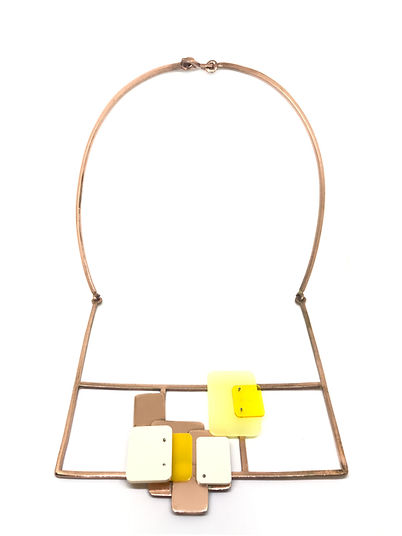
Influenced by the artistic avant-garde of futurism, the Kinetic series of pieces seeks to reflect the movement and dynamism characteristic of this school of thought. The superimposition of planes and linear elements, together with the chromatic and opacity variations, manage to build emblematic pieces of wearable art.
Entirely handmade, the pieces were materialized in silver-plated metal and acrylics of various shades and translucencies, generating a different sensation of depth in each unique piece.


Process


Necklace
Earrings

Necklaces
LATIN AMERICAN WOMEN ARTISTS
This series of bracelets is a tribute to the most representative and pioneering women of Latin American art. Each artist selected for this project has contributed to transforming the course and very conception of art itself. These remarkable women have made highly significant contributions to the shift in perspective that has taken place in contemporary art in recent years—one that now allows for a focus on Latin femininity and artistry.
The unique pieces aim to evoke the most powerful or characteristic elements of each chosen artist’s style. True to Isabel Englebert’s essence, the bracelets present an almost absolute synthesis of the formal and aesthetic qualities of the artist they reference, resulting in pure, nearly geometric abstractions. Materials such as bronze and alpaca play a central role in these pieces, creating an atmosphere of sophistication and singularity.
Through volume, engravings, textures, and cutouts, Isabel Englebert constructs and reconstructs the universe of these strong and valuable women. The artists featured in this series are Frida Kahlo, Tarsila do Amaral, Ana Mendieta, Zilia Sánchez, Mirtha Dermisache, Marta Minujín, and Lygia Clark.
FRIDA KAHLO
Height: 6cm

A piece inspired by the iconic braids worn by Frida Kahlo in her hairstyles.
Frida Kahlo (Mexico 1907-1956) was one of the most representative artists of Latin American culture. She created an entirely subjective and deeply metaphorical style, influenced by her great sensitivity and her autobiographical references, marked by powerful life events.
At the age of eighteen, Frida Kahlo suffered a serious accident that forced her into a long convalescence, during which she learned to paint. This experience had a decisive influence on the creation of her complex psychological world, so characteristically reflected in her works.
Self-portraiture is central to her art, creating an atmosphere often described as both surreal and spontaneous. Her distinctive features—such as the braid encircling her head and her unibrow—have become enduring symbols of art itself.


TARSILA DO AMARAL
Height: 6cm
A bracelet inspired by the cactus-like forms characteristic of Amaral’s paintings.
Tarsila do Amaral (Brazil 1886-1973) is the most famous Brazilian artist of the 20th century, although she has only gained international recognition in recent times.
She studied painting in Paris, bringing modernist elements to her homeland—such as flattened forms and distorted bodies. However, she infused this style with her own distinct touch, deeply rooted in Brazilian culture.
Do Amaral filled her canvases with vibrant scenes of Brazilian life, its lush vegetation, and the powerful bodies of female figures. These paintings inspired Brazil’s Anthropophagy movement, which encouraged artists to define a new and unique Brazilian style by “cannibalizing” aspects of Western art. Her practice was crucial in shaping the visual national identity of her country.


ANA MENDIETA
Height: 7cm

A bracelet inspired by amorphous forms shaped in the earth, and by edges that evoke the artisanal and the ancestral.
Ana Mendieta (Cuba, 1948-1985) was a major Cuban artist who developed a powerful visual language centered on womanhood, the feminine, the body, the earth, and violence. An interdisciplinary creator, she produced sculptures, videos, photographs, and performances that gave rise to what became known as earth-body art.
Mendieta discovered what she could express through multiple forms—most profoundly through her own body. She camouflaged her nude figure within natural landscapes, portrayed herself with a beard, reenacted scenes of assault, pressed her body against glass to distort it, and, most notably, covered herself in blood.
Her work explored the meanings of life and death, while also embracing a sacred, ritualistic dimension that referenced the origins of Cuban culture. Mendieta’s art sought to reclaim the ancestral and the primal, establishing her as one of Latin America’s most significant artists—a symbol of the connection between the female body and nature.


ZILIA SÁNCHEZ
Height: 7cm
A bracelet inspired by pointed forms that evoke the erotic and the contours
of the female bust.
In the 1960s, Zilia Sánchez (Cuba, 1928) reinvented hard-edge geometric abstraction by introducing canvases with unconventional shapes and undulating morphologies that evoke sensuality and eroticism.
In Sánchez’s three-dimensional paintings, the pointed areas of the canvas extend outward into space, creating a resemblance to female nipples. Other works feature openings that recall vulvas and other bodily orifices.
Her art stands as a representation of expressionism and erotic sensuality, the female body, and the symbolism of the earth’s fertility.


MIRTHA DERMISACHE
Height: 7cm

A bracelet inspired by Dermisache’s asemic writing and graphic gestures.
Mirtha Dermisache (Argenitna 1940) was an artist who explored writing, graphic expression, and the asemic. Beginning in 2004, and in collaboration with Florent Fajole, she created a series of editorial devices that explored the dimensions of installation and the printing process, highlighting various conceptual aspects of publications within a single spatial reality.
Her first solo exhibition in Buenos Aires took place at The Edge Gallery. She later presented her work at the MACBA (Barcelona) and the Centre Pompidou (Paris).
Her practice was grounded in the act of unlearning—a reflection on codes, language, and expression itself.


MARTA MINUJÍN
Height: 7cm
A bracelet inspired by the rhythmic stripes that flow back and forth across Minujín’s paintings and sculptures.
Marta Minujín (Argenitna 1943) is one of the most internationally renowned Argentine artists. Her transgressive art laid much of the groundwork for contemporary Argentine art.
Her plush sculptures, environments lit with bright neon lights, and public performances invited active participation and physical engagement. Minujín transformed multicolored mattresses into bulging forms that referenced the human body, sexuality, and rest. These became central elements in immersive environments where she encouraged participants to shed their inhibitions and express themselves freely.
Minujín’s work has also addressed political issues such as the evils of totalitarian regimes and oppression, using objects loaded with symbolism—like books once banned by Argentina’s former dictatorship. She stands as a symbol of freedom, expression, and transgression.


LIGHYA CLARCK
Height: 7cm

A bracelet inspired by the volumetric and laminar forms, and the pure geometry proposed by Clark.
Lygia Clark (Brasil, 1920-1988) was a pioneering artist in interactive and immersive art, breaking the boundaries between art and life.
Clark began her practice by exploring geometric abstraction, drawing early inspiration from European modernists. However, she soon broke away from this style by bringing the hard-edged forms of her paintings into three-dimensional space. Her canvases began to project outward, and she started creating angular, three-dimensional sculptures that could be physically manipulated by viewers. Later in her life, Clark shifted her focus from creation to psychological practice. Building on her early observations of people interacting with her sculptures, she developed therapeutic methods in which patients engaged with objects as part of their healing process.


IRIS

